A research program for collective-aware artificial intelligence

Collective-State
Inference (CSI)

Inferring latent, emergent collective conditions from observable interaction patterns.

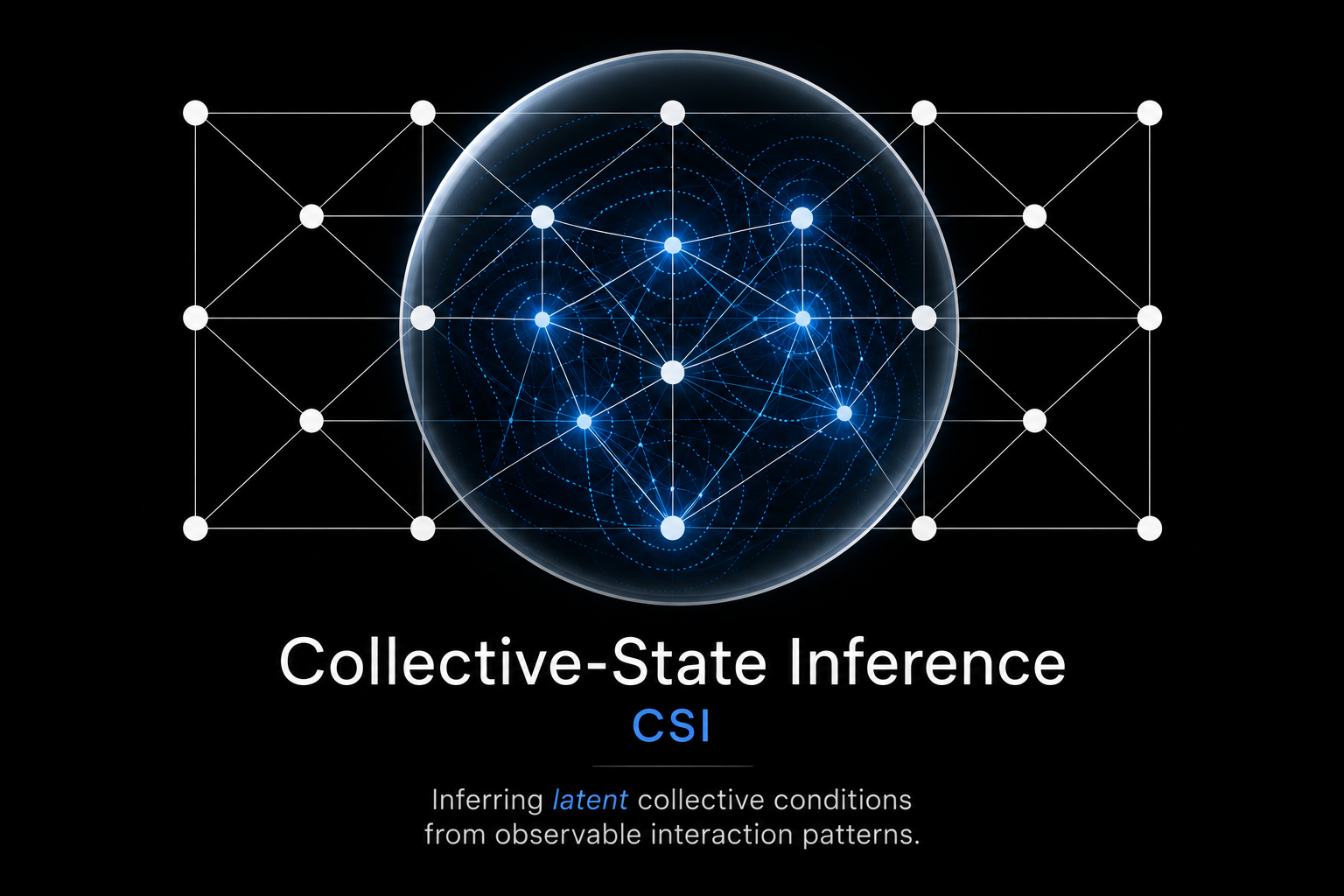
The CSI Lens visualizing hidden relational structure within an observed interaction network

Canonical definition

What is Collective-State Inference?

Collective-State Inference (CSI) is the process by which an AI system infers latent, emergent collective conditions—such as engagement, cohesion, conflict, and alignment—from observable interaction patterns among multiple participants within a shared environment.

These conditions arise from collective dynamics and cannot be fully explained by aggregating the states, attributes, or behaviors of individual participants.

01

Observe interaction

Communication, participation, timing, reciprocity, influence, subgroup formation, and contextual events provide observable evidence.

02

Infer collective state

AI integrates individual, relational, temporal, and contextual evidence under an explicit theory of composition.

03

Support collective awareness

Calibrated estimates can be interpreted, projected, explained, and used to support responsible human judgment.

The defining visual

The CSI Lens

The observed network remains unchanged. CSI adds an inferential layer that makes latent relational structure perceptible.

The lens does not claim direct access to an invisible truth. It represents a theory-guided, probabilistic process through which AI estimates collective conditions from incomplete and context-dependent signals.

  • White nodes represent participants or entities.
  • White edges represent observable interactions.
  • The lens represents the CSI inference process.
  • Blue structures represent inferred collective conditions.
CSI visual language and design system

Why CSI?

Organizations are not simply collections of individuals.

Trust, alignment, cohesion, conflict, engagement, and shared purpose emerge through interaction. Two groups can have similar individual-level averages yet differ profoundly in reciprocity, subgroup structure, influence concentration, or trajectory.

Individual analytics asks

What does this person feel, prefer, intend, or do?

CSI asks

What condition is emerging within the collective—and how is it changing over time?

Cumulative research program

Research roadmap

Paper 1

Theoretical foundation

Define CSI, collective states, collective awareness, construct boundaries, composition logic, validation, and governance.

Current manuscript
Paper 2

Operationalization

Specify constructs, indicators, ground-truth strategy, comparison models, and empirical measurement design.

In development
Paper 3

Empirical validation

Test construct, incremental, predictive, and nomological validity across bounded teams or communities.

Planned
Paper 4

Collective awareness

Study interpretation, projection, explanation, human reliance, and behavioral consequences.

Planned
Paper 5

Collective-aware systems

Design and evaluate responsibly governed AI systems in real organizational and collaborative environments.

Long-term program

Research outputs

Publications and presentations

Manuscript in preparation

Collective-State Inference: A Multilevel Computational Framework for Collective Awareness in Artificial Intelligence

A conceptual paper integrating emergence theory, multilevel theory, organizational research, computational social science, and artificial intelligence.

Target journal
Computational and Mathematical Organization Theory

Current stage
Reviewer draft

A public manuscript link will be added when an appropriate preprint or accepted version is available.

About the research

From system observability to collective inference

The CSI research program grew from a question shaped by years of work in enterprise and multi-cloud architecture: if observability helps us infer the internal state of complex software systems, could related principles help AI reason more rigorously about the collective conditions that emerge within human systems?

The program bridges enterprise architecture, artificial intelligence, organizational theory, computational social science, and responsible system design.

Edward D. Clark

Enterprise and Multi-Cloud Solutions Architect

MBA (Artificial Intelligence) candidate

Independent researcher developing the Collective-State Inference framework

Research collaboration

Connect

For academic feedback, research collaboration, conference discussion, or responsible applications of collective-aware AI:

Contact Edward Clark