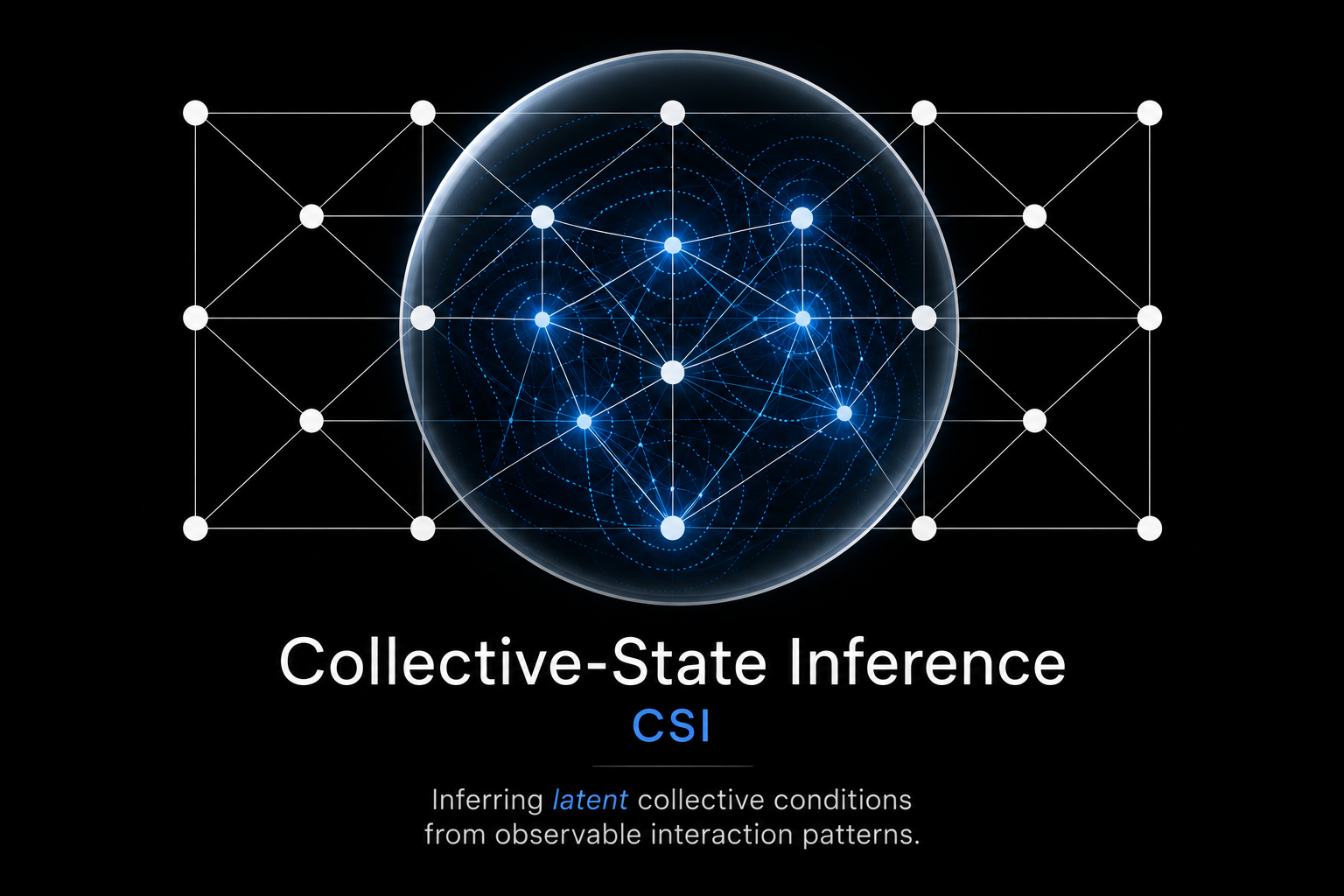
The CSI Lens revealing latent relational structure within an observed interaction network
The CSI Lens distinguishes observable interaction evidence from relational structure that may support a qualified collective-state estimate.

An independent research program for collective-aware artificial intelligence

Collective-State
Inference (CSI)

The collective is the object of inference.

A computational organization theory for inferring latent collective conditions from observable interaction evidence.

Explore the idea

The central idea

The collective is the object of inference.

Collective-State Inference (CSI) is the process by which an AI system infers latent conditions of a bounded collective—such as engagement, cohesion, conflict, and alignment—from observable individual, relational, temporal, and contextual evidence.

Collective states are defined at the level of the collective. Their relationship to lower-level evidence depends on an explicit composition model: for some constructs aggregation may be appropriate, while others require relational, temporal, contextual, or configurational evidence.

01 · Collective state

The condition being estimated

A latent, temporally situated property of a bounded collective.

Why it matters: Groups with similar individual averages may differ in how their members interact. Where those relationships matter to the target construct, its measurement must represent them; aggregation remains appropriate when justified.

Explore the state rationale
02 · Collective-state inference

The reasoning from evidence

The process of estimating a collective condition from observable evidence.

Why it matters: The same behavior can support different interpretations. A state estimate therefore needs a justified link between evidence and construct, comparison with alternatives, and independent validation.

Explore the inference rationale
03 · Collective awareness

The capacity to use an estimate

The capacity to interpret, project, explain, and support reasoning about validated collective-state estimates.

Why it matters: Producing an estimate does not establish that a system can use it appropriately. Interpretation and decision support require separate evaluation, with uncertainty and human oversight preserved.

Explore the awareness rationale

These explanations draw on established scholarship. CSI proposes to connect them in a common inferential specification; its distinctive theoretical and empirical value remains to be demonstrated. Read the contribution and its boundaries.

Start here

Choose the path that matches your purpose.

Learn the concepts

CSI Reference

Canonical, versioned articles covering definitions, construct boundaries, methods, validation, uncertainty, and collective-aware systems.

Open the Reference
Follow the science

Research Program

Research questions, proposed contributions, staged studies, current status, and the cumulative roadmap for CSI.

View the research program
See the model

Framework

A concise visual overview of the evidence, inferential process, collective-state estimate, uncertainty, and application layer.

Explore the framework
Inspect the instrumentation

Research Observatory

A delayed, privacy-preserving prototype showing how audience interaction observations are transformed into aggregate indicators and candidate evidence. It does not claim that website visitors constitute a CSI-qualified bounded collective or that its outputs are validated collective-state estimates.

Open the Observatory
Review the record

Scholarly outputs

Manuscripts, archival editions, DOI records, source registries, and future empirical outputs from the research program.

View research outputs

Emerging application domain

CSI and agentic AI

As AI systems increasingly operate as teams of interacting agents, evaluating individual-agent performance alone may not describe the condition of the collective. CSI provides a framework for asking whether a bounded agent collective exhibits a theoretically meaningful collective state—and what evidence would be required to warrant that inference.

Candidate research constructs for agentic systems include coordination coherence, influence concentration, fragmentation, collective goal drift, resilience, and susceptibility to cascading compromise. CSI does not assume that multi-agent activity, agreement, or successful task completion automatically constitutes a collective state; the construct, composition logic, evidence, uncertainty, and validation requirements must be made explicit.

01

Human collectives

Infer qualified collective conditions from human interaction evidence.

02

Hybrid collectives

Study collective states where humans and AI agents participate together.

03

Agent collectives

Compare bounded agent teams that achieve the same task result but differ in reciprocity, influence concentration, information provenance, temporal stability, and resilience. CSI asks whether those patterns support defensible estimates of different collective conditions.
Explore the AI-agent illustration

See CSI in context

A synthetic operationalization makes the inferential chain concrete.

Illustrative CSI Operationalization

Follow a hypothetical Vibe Village-inspired collaborative listening session from a bounded collective and observable interaction traces to a candidate estimate of collective engagement. The example uses synthetic data and does not represent an implemented or empirically validated CSI system.

Explore the illustration

Current scholarly work

A developing scholarly record.

Research manuscript · In peer review

Collective-State Inference: A Computational Organization Theory for Collective-Aware Artificial Intelligence

The theoretical foundation for CSI, positioning collective-state estimation as a computational organization theory with explicit construct level, composition logic, dynamic updating, uncertainty, nested comparison models, validation, and governed use.

Current status
Unpublished and currently in journal peer review. Peer review is ongoing; the manuscript has not been accepted, and CSI has not yet been empirically validated.

Current research priority — Theory testing and empirical preparation

The program continues to test CSI against neighboring traditions while advancing a positive contribution claim: CSI specifies when heterogeneous computational representations warrant interpretation as latent collective conditions, rather than claiming that collective states have never previously been computational targets.

View the current priority

CSI Reference, Edition 0.1

The first archival edition establishes the canonical conceptual foundation, version history, scholarly sources, editorial policy, and reuse terms.

Review Edition 0.1

View the complete outputs record

About the researcher

Edward D. Clark

Edward D. Clark is the founder and sole researcher of the Collective-State Inference research program. His work draws on enterprise architecture, distributed systems, observability, organizational theory, computational social science, and artificial intelligence to examine how AI systems might infer conditions emerging within human, hybrid human–AI, and artificial-agent collectives.

The initial inspiration for CSI emerged during the conception and development of Vibe Village, a social-music platform centered on shared listening and collective participation.

Read the full researcher profile

Current profile

Founder and sole researcher
Collective-State Inference

Professional field
Enterprise and Multi-Cloud Solutions Architecture

Current degree
Executive MBA, Artificial Intelligence — Candidate
University of East London
Expected: July 2027

Executive education
Chief Technology Officer Programme
Cambridge Judge Business School, Executive Education
Completed: 2024

View research outputs

Research collaboration

Connect

For academic feedback, research collaboration, conference discussion, or responsible applications of collective-aware AI:

Contact Edward Clark